


2025 Mitsubishi Outlander close to Frederick, MD
The 2025 Mitsubishi Outlander presents a series of engineering updates designed to refine vehicle response and operational consistency. A 2.5-liter twin-cam four-cylinder gasoline engine produces 181 horsepower at 6000 rpm and 181 pound-feet of torque at 3600 rpm. Power delivery is supported by an eight-speed sport mode continuously variable transmission that has been calibrated to provide step-shift characteristics so gear changes feel predictable during acceleration. This configuration helps maintain smooth transitions and steady torque application during both light throttle cruising and rapid throttle engagement. Engineers placed emphasis on consistent behavior through the full operating range so the engine and transmission work together without abrupt hesitation during load changes.
The transmission uses an optimized torque converter that supports improved response during initial throttle input. Step shift control in Drive mode creates uniform shift sensations that mimic a traditional automatic transmission while retaining the drivetrain efficiency advantages of a CVT. Acceleration mapping was refined to provide linear engagement during merging situations while still maintaining quiet operation during steady speed travel. These combined changes allow the powertrain to deliver predictable performance across varying conditions without excessive vibration or mechanical harshness.
Advanced S A W C Operation and Drive Mode Functionality
The available Super All-Wheel Control system integrates electronically controlled four-wheel drive with Active Yaw Control and four-wheel brake control through the Adaptive Stability Control system and the Anti-lock Braking system. Sensors continuously monitor steering wheel input, wheel speed, driving torque, brake pressure, and yaw rate so torque distribution between the front and rear wheels can be adjusted as needed. The electronically controlled hydraulic clutch responds precisely to load variation, which helps reduce wheel slip when traction is limited. By managing distribution without mechanical delay, the system provides consistent acceleration on slippery surfaces and maintains directional stability during turns.
Active Yaw Control applies targeted braking to both front and rear wheels to generate a yawing moment that supports balanced cornering. This helps the vehicle hold the intended line when lateral forces increase. Four-wheel brake control can simulate a differential lock by applying brake pressure to a slipping wheel, which improves traction when diagonal wheels lose contact or face low conditions. Front-wheel-drive models also benefit from Brake AYC, which works with the stability control and anti-lock braking systems to support predictable cornering behavior through controlled brake application.
Drive mode selection allows the system to modify vehicle response through dedicated calibrations. Normal mode supports consistent daily driving characteristics with balanced steering and throttle mapping. Tarmac mode increases dynamic feedback for paved surfaces through revised steering weight and sharper drivetrain response. Gravel mode adjusts traction control behavior to support stability on unpaved surfaces. Snow mode increases emphasis on directional control on low-friction surfaces. Mud mode is exclusive to S A W C models and adjusts control strategies to support movement through deep material and similarly demanding conditions.
Steering Architecture and Suspension Revisions
The 2025 Mitsubishi Outlander incorporates a dual pinion electric power steering system with the assist motors positioned near the wheel ends so steering response remains linear and accurate. Engineers refined the on-center weight to support driving stability at consistent speeds. The updated calibration helps produce steady feedback without excessive resistance, which reduces driver fatigue on longer drives. The Tarmac drive mode increases steering weight to create additional surface feedback so inputs feel more defined during cornering.
Suspension componentry underwent extensive adjustment for the new model year. Forged aluminum front lower arms and rear upper arms reduce mass while preserving rigidity. Hollow stabilizer bars at both front and rear locations further reduce weight while maintaining roll stiffness. Springs and shock absorbers were retuned with revised compression and rebound characteristics that reduce abrupt vertical motion during initial bump contact. The front stabilizer bar diameter was changed from 25 millimeters to 23.5 millimeters, which contributes to improved compliance while retaining structural control. Engineers also developed a new tire specification that matches the updated suspension geometry and noise reduction enhancements so ride quality and grip remain consistent during varied driving.
Structural Engineering and NVH Management
The 2025 Mitsubishi Outlander continues to use Mitsubishi’s Reinforced Impact Safety Evolution unibody system that distributes collision energy across key structural zones. Ultra-high tensile strength steel with hot stamping is applied around the cabin to reduce deformation while maintaining a lighter overall structure compared to conventional steel formats. Floor members beneath the vehicle are arranged to disperse frontal impact energy and to reduce floor vibration. These structural choices contribute to both occupant protection and steady ride quality without excessive chassis flex.
Engineers applied expanded sound insulation throughout eighteen areas of the vehicle body. Added material in the A-pillar and B-pillar trims reduces wind intrusion and structural resonance. Door panel sound isolators received increased size and modified shape so vibration travel between outer panel layers is reduced. Rear quarter trim received a larger isolator area for improved damping. Additional insulation was added around the air conditioning ductwork, the carpet, the center console, the transmission tunnel, and the cowl side trim. These updates result in more than a half-decibel reduction in road noise and nearly six decibels of overall sound isolation improvement compared to the prior model year.
Front center airbag technology has been added. The system deploys between the driver and front passenger during a side collision to reduce the chance of occupant contact. This joins the existing airbag network integrated into the unibody structure.
Exterior Structural and Design Updates
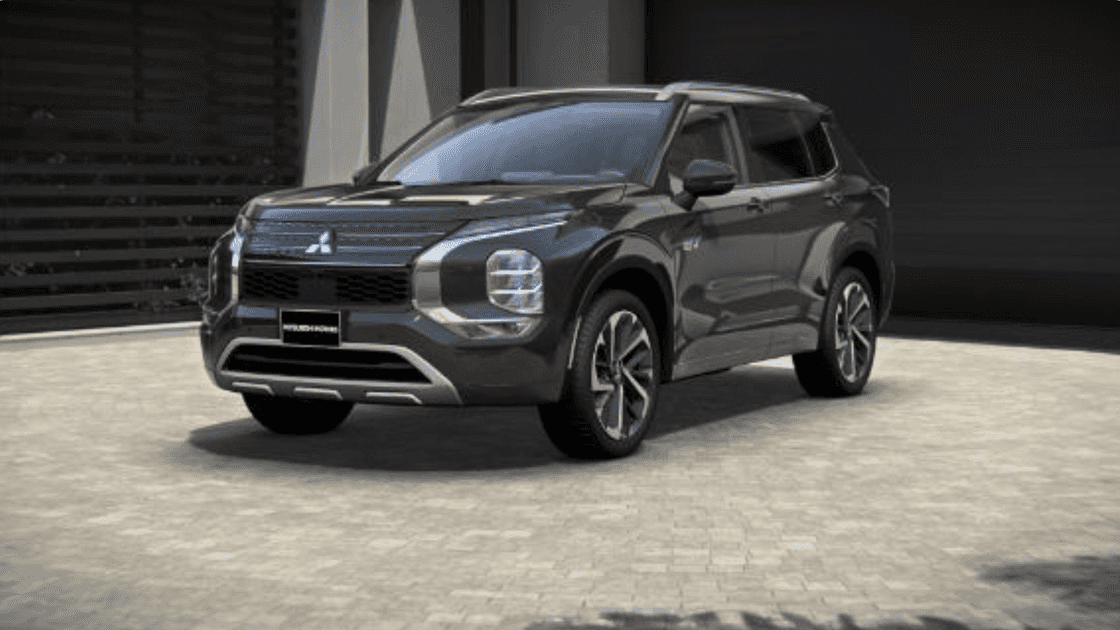
The exterior of the 2025 Mitsubishi Outlander presents refinements that support function as much as appearance. Engineers introduced steel construction for the hood and front fenders to improve noise, vibration, and harshness control. This material change allows tighter build tolerances while improving damping. A redesigned upper grille section integrates with the clamshell-style hood so the front profile appears smoother and more uniform. Full LED lighting is standard for all exterior and interior positions. The lighting configuration includes high-positioned daytime running lamps that enhance vehicle recognition and low-mounted headlamps that reduce glare for oncoming traffic. LED fog lamps sit beneath the headlamps and improve forward visibility through dense moisture at road level.
The side profile design maintains a strong horizontal structure supported by muscular fender contours and a prominent jet tail rear pillar that produces a floating roof appearance. Sculpted surfaces create the impression of solid mass and consistent shaping. Rear lighting uses a T-shaped Grand Horizon layout with smoked lenses that produce a deep three-dimensional effect. The rear structure incorporates a hexagonal motif inspired by the liftgate of the historical Montero and Pajero. Updated 18- and 20-inch wheel designs are available depending on trim and are paired with large-diameter ventilated brake discs that measure 13.8 inches in front and 13.0 inches in the rear.
Interior Ergonomics and Material Engineering
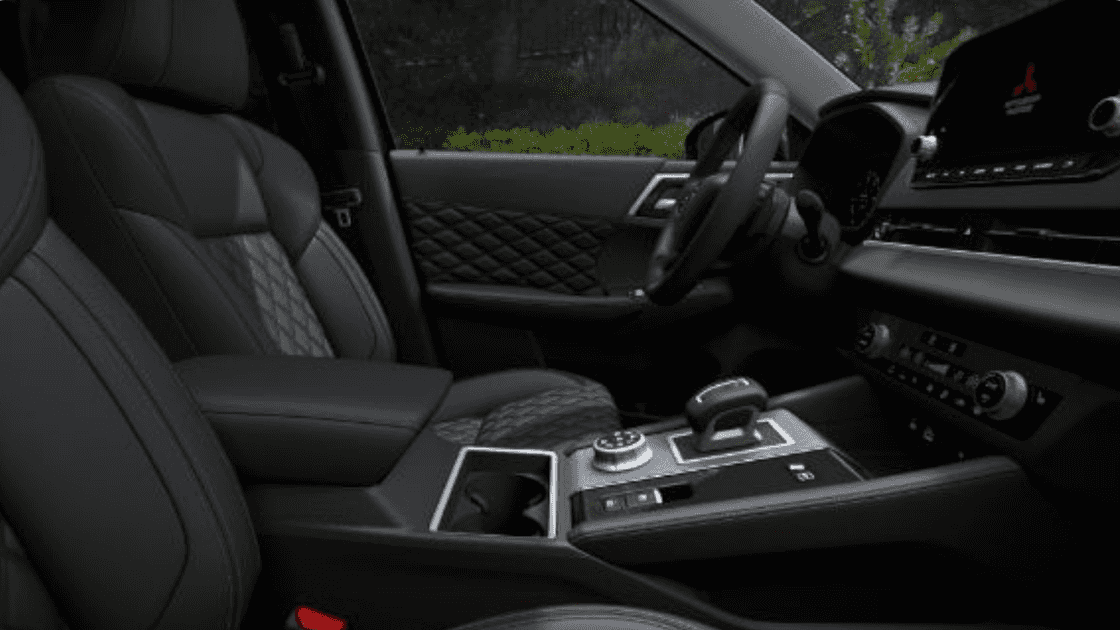
Interior design revisions address functional concerns identified through customer feedback. The center console was redesigned to increase the armrest storage volume from 152 cubic inches to 268.5 cubic inches. The wireless charging pad was reshaped so phones of varying dimensions maintain consistent contact. Cupholders were repositioned near the gear shift for improved accessibility, and each cupholder was molded at a slightly different angle so two large containers can fit without contact.
Seating materials vary by trim and include a new Brick Brown semi-aniline leather option with diamond stitching patterns along seat surfaces and door panels. A light gray synthetic leather with suede-like inserts is available on mid-level trims. Ventilated front seats appear for the first time in any Mitsubishi model, and heated second-row seating is available as well. The second-row seat design was updated with optimized urethane pad firmness, a revised support wire arrangement, and extended seat back length to improve spinal and shoulder support. A one-action folding mechanism along with a remote lever located in the luggage area allows the second row to fold without opening the rear doors. The 40/20/40 split configuration accommodates long items while retaining seating for two passengers. When the second and third rows are folded the usable cargo length reaches 80.3 inches. LED interior lighting replaces prior incandescent bulbs and produces focused coverage with reduced glare.
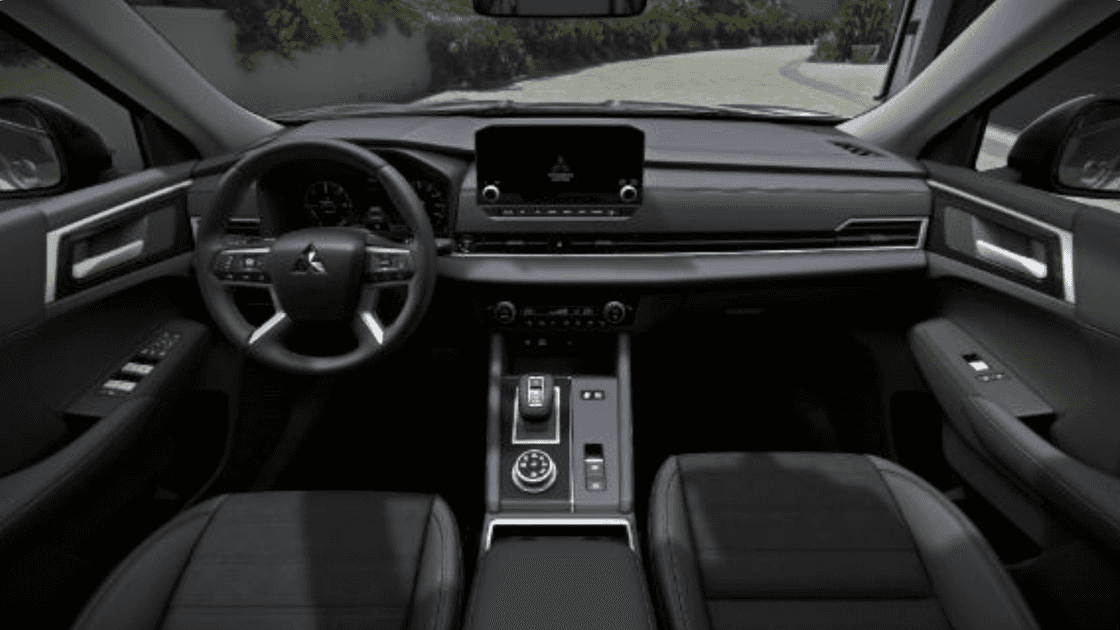
A 12.3-inch digital driver display aligns visually with the floating infotainment display above the center stack. Fonts and interface elements remain consistent across both screens, which is a detail typically found in luxury-class models. A new frameless digital rearview mirror offers either a conventional reflective surface or a live image from a rear-mounted camera, which improves visibility when cargo or environmental conditions obstruct the rear window.
Audio Systems and Digital Integration
The 2025 Mitsubishi Outlander introduces Yamaha-developed in-car audio for the first time in the North American market. Two configurations are offered. The Dynamic Sound Yamaha Premium system uses eight speakers supported by tuning principles derived from Yamaha’s NS 5000 speaker technology. The Dynamic Sound Yamaha Ultimate system uses twelve speakers, including a subwoofer, and produces 1650 watts of power through dual amplifiers equipped with Yamaha digital signal processing. The system employs Finite Impulse Response tuning and three-dimensional Spacious Sound processing so the audio environment remains consistent across varying seats. Listening modes include Lively, Signature, Powerful, and Relaxing, so users can adjust tonal character. The system also supports compensation for vehicle speed, precipitation, and ventilation fan speed so frequency output remains clear during operation.
A 12.3-inch Smartphone Link Display offers a high-resolution 1280 by 720 touchscreen with updated graphics consistent with the audio interface. Wireless Apple CarPlay® and wireless Android Auto™ are supported for driver connectivity. Navigation features include Street View and Satellite View through integrated Google services. Remote vehicle services allow access to locking, climate control, and status functions through connected systems.
Visit Younger Mitsubishi for a Test Ride
The 2025 Mitsubishi Outlander presents a technical package built on refined drivetrain behavior, revised suspension geometry, advanced electronic traction management, and expanded cabin digital systems. These features work together to produce consistent performance and predictable response across a wide range of driving situations. A test drive provides the most accurate understanding of how the powertrain, chassis tuning, and interior systems function as a complete vehicle. We invite you to experience these characteristics for yourself at Younger Mitsubishi close to Frederick, MD, and explore the engineering updates that define this model. Our team is ready to assist you with a demonstration and provide all technical details during your visit.